



In his Address to the Nation, President Kassym-Jomart Tokayev outlined a clear vector of economic policy: increasing non-commodity exports, modernizing trade infrastructure, and creating conditions for the competitiveness of domestic producers in the global arena.
– Kazakhstan’s trade policy must be proactive. We should not merely sell raw materials; we must export finished products, creating jobs, increasing incomes, and ensuring foreign currency inflows, – the Head of State emphasized.
Amid intensifying competition, unstable geopolitics, and the transformation of global trade, Kazakhstan is confidently moving towards expanding its export potential. Today, this is not just a task of increasing foreign trade volumes, but a strategic goal of sustainable national economic development.

According to Aitmukhamed Aldazharov, CEO of the “QazTrade” Trade Policy Development Center JSC, by the end of 2024 Kazakhstan’s foreign trade turnover reached $142.1 billion – a 1.8% increase compared to the previous year.
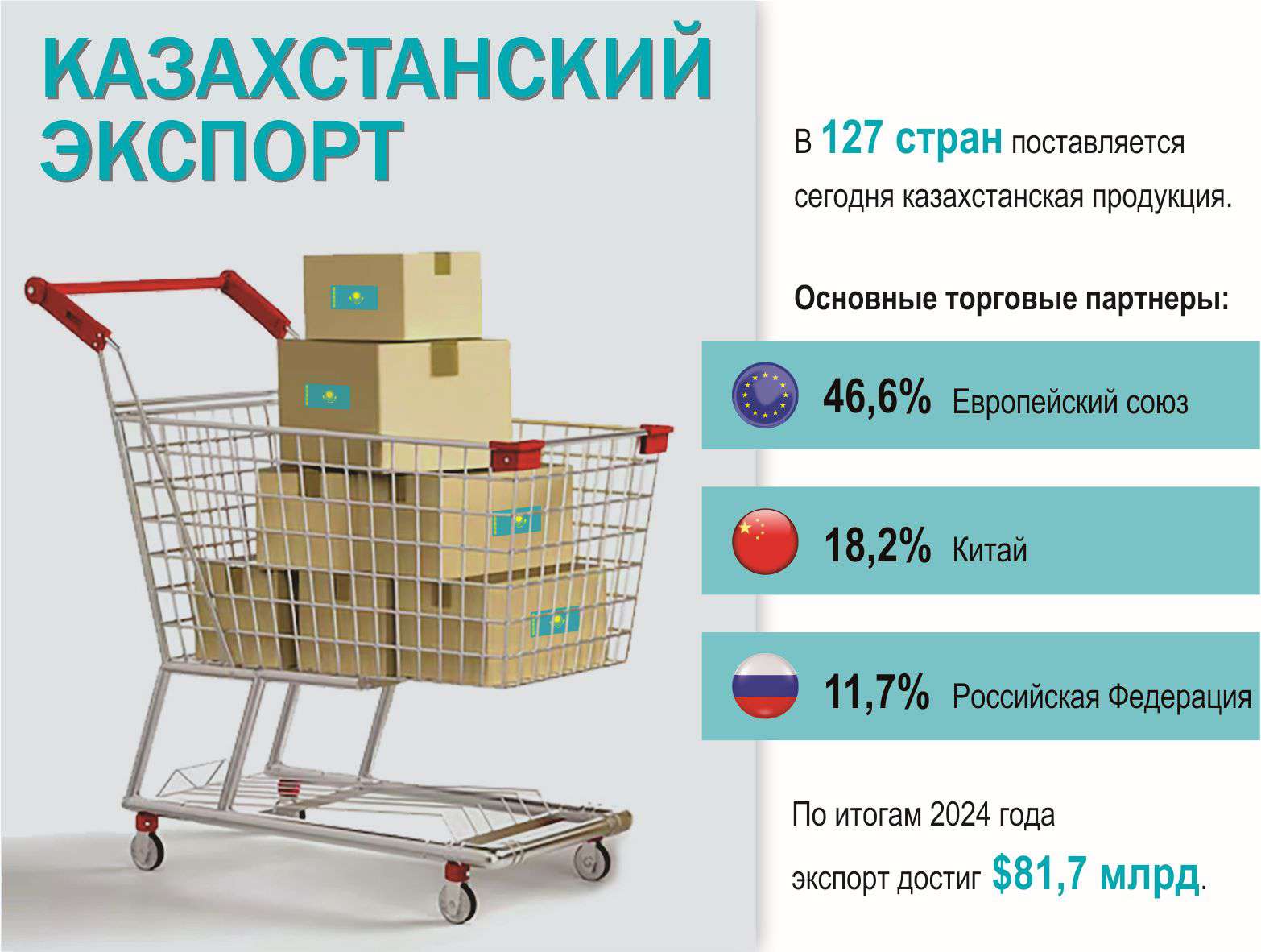
Exports amounted to $81.7 billion, or 57.5% of total trade. Over the past five years, Kazakhstani exports have grown by almost 72%. These figures reflect not only favorable market conditions, but also systematic government policies aimed at supporting exporters, modernizing logistics, and developing non-resource sectors.
Focus on Sustainability
Today, Kazakhstani products are supplied to 127 countries worldwide, reflecting the high level of the country’s integration into global trade processes.
The main trading partners remain the European Union (46.6% of exports), China (18.2%), and the Russian Federation (11.7%). Together, they account for more than 75% of Kazakhstan’s exports.
Nevertheless, the national strategy emphasizes diversification of external markets. The Middle East, South and Southeast Asia, Iran, and the Republic of Korea are gaining increasing significance. These markets demonstrate rapid economic growth and rising demand for food products, industrial components, agricultural goods, and IT services.
– Our goal is not just to sell more, but to form sustainable export chains where Kazakhstan becomes a reliable partner with high-quality products, – noted Aitmukhamed Aldazharov.
As a national foreign trade development institution, QazTrade implements a comprehensive policy of supporting Kazakhstani exporters. The export acceleration program covers up to 120 companies annually.
In the first half of 2025 alone, with QazTrade’s support, 83 export contracts worth more than $117 million were signed. Notable examples include “Industry of Zhetysu” LLP, with $76 million worth of deliveries to China, Russia, and Uzbekistan, and Qazaq-astyq Group, with $26 million in export revenue.
– We help not just to sell products, but to build a strategy for entering the international market: from marketing and certification to negotiation support, – explained the head of QazTrade.
Among the most in-demand support measures are assistance in entering international e-commerce platforms, reimbursement of transportation and promotion costs, organization of national stands at exhibitions, and business missions abroad.
From flour to pharmaceuticals and IT services
QazTrade plays a key role in developing non-resource exports. The focus is on products with high added value – machinery, agro-industrial complex, chemicals, food industry, pharmaceuticals, and digital services.
– We are focused not on raw material volumes, but on products that embody labor, technology, and ideas. Kazakhstani companies are already participating in tenders in the Middle East, supplying IT solutions to Central Asia, and exporting processed food to China, – said Aitmukhamed Aldazharov.
For example, Centrasia Group secured a long-term engineering contract in Qatar, while Kazakhstani IT companies are entering the UAE and Saudi Arabian markets.
However, export development faces several constraints. Firstly, global economic growth is slowing: the World Bank forecasts only 2.3% global growth in 2025. Secondly, the structure of trade is changing: services are growing faster than goods. Moreover, environmental barriers are strengthening.
– Starting in 2026, the EU will introduce full carbon payments under CBAM, which is already affecting exports of metals, fertilizers, and other energy-intensive goods from Kazakhstan, – explained the expert.
Logistics also remains a “bottleneck”: as a landlocked country, Kazakhstan faces high transportation costs. International studies show that for such countries, the logistic cost of exports is 63% higher than average.
Nevertheless, steps are being taken: the Middle Corridor is being developed, logistics digitalization is accelerating, and transport procedures are being improved.
In the next five to ten years, Kazakhstan must realize its potential in three key areas. Firstly – increasing the production and deep processing of critical materials. The Republic remains a global leader in uranium production, and supplies titanium and rare metals. The task now is not only to export raw materials, but also to develop processing – smelting, refining, and semi-finished products.
Secondly, with the growth of the world population, demand for processed agricultural products is rapidly increasing. Kazakhstan has already adopted a processing development plan until 2028, focusing on oils, gluten, dairy products, and ready-made food.
Thirdly, Kazakhstan is successfully mastering digital trade formats: electronic certificates, paperless logistics, and border procedure automation. According to the OECD, this could add up to 18% to goods exports.
– Digitalization is not just a trend, it is a competitive advantage. We already see how the export of IT services and solutions is generating real income and foreign exchange revenues, – noted the speaker.
Export – not one-off deals
Trade agreements play an invaluable role in expanding the country’s export opportunities. First and foremost – participation in the EAEU, which gives Kazakhstan access to a single market with simplified movement of goods and services. The union accounts for 22% of Kazakhstan’s foreign trade turnover.
Agreements have also been concluded with China, Vietnam, Iran, Serbia, and the UAE. Between 2015 and 2024, trade turnover with Vietnam increased 4.2 times, and with Serbia – 6.4 times.
– Our task is to expand the network of such agreements, including strategic markets. They reduce barriers, provide predictability, and open new niches for Kazakhstani business, – believes Aitmukhamed Aldazharov.
Cooperation with the EU is of particular significance, where the Enhanced Partnership Agreement is in force. This is not only access to the largest consumer market, but also a mechanism for attracting investments, implementing technologies, and improving standards.
In other words, today’s export is not one-off deals, but long-term trusted relationships. Kazakhstan is building infrastructure, institutions, and rules that allow businesses to feel confident in the global market.
– We are building not just exports, but a system of sustainable presence in external markets. This takes time but is already bearing fruit. Our task is to develop together with business, to be flexible, technological, and competitive, – summarized the head of QazTrade.